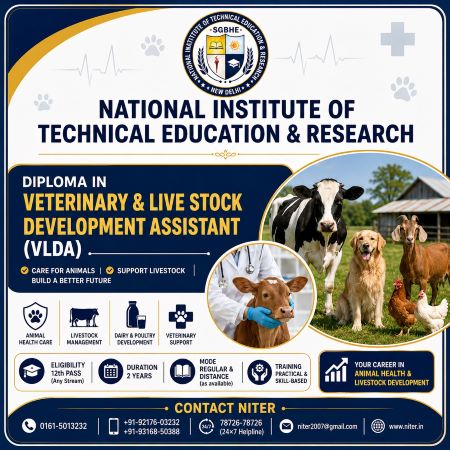
Diploma in Veterinary & Live Stock Development Assistant (VLDA): Course Details, Eligibility, Duration, Career & Admission Guide (2026)
Diploma in Veterinary & Live Stock Development Assistant (VLDA): Complete Course Guide
The livestock and animal healthcare sector plays a vital role in agriculture and the rural economy. With increasing awareness of animal health, dairy development, poultry farming, and livestock management, there is a growing demand for trained veterinary support professionals.
The Diploma in Veterinary & Live Stock Development Assistant (VLDA) is a vocational skill development programme designed for students who wish to build practical knowledge of animal healthcare, livestock management, disease prevention, nutrition, breeding practices, and veterinary support services under applicable laws and institutional guidelines.
This course combines theoretical learning with practical training, making it an excellent choice for students who wish to pursue a career in veterinary assistance, animal husbandry, dairy development, poultry management, and livestock welfare after completing their 12th standard.
What is the Diploma in Veterinary & Live Stock Development Assistant (VLDA) Course?
The Diploma in Veterinary & Live Stock Development Assistant (VLDA) course is a skill-oriented vocational programme that introduces students to the fundamentals of veterinary science, livestock development, animal nutrition, animal breeding, disease prevention, first aid for animals, dairy management, poultry farming, and livestock healthcare support.
The programme focuses on developing practical skills required to assist veterinary professionals, support livestock development programmes, promote animal welfare, and contribute to modern animal husbandry practices.
Students receive both classroom education and practical exposure to understand scientific livestock management and animal healthcare support services.
Course Highlights
| Particular | Details |
|---|---|
| Course Name | Diploma in Veterinary & Live Stock Development Assistant (VLDA) |
| Eligibility | 12th Pass (Any Stream) |
| Duration | 2 Years |
| Mode | Regular & Distance (as available) |
| Medium | Hindi / English |
| Examination | Annual |
| Training | Practical & Skill-Based Learning |
Why Choose the VLDA Course?
The Veterinary & Live Stock Development Assistant course provides excellent opportunities for students interested in animal healthcare and livestock management without pursuing a full veterinary degree.
Some major advantages include:
- Practical veterinary support education
- Growing demand in the livestock sector
- Knowledge of dairy and poultry management
- Animal healthcare and welfare skills
- Livestock development training
- Opportunities in rural development projects
- Foundation for higher veterinary education
- Self-employment opportunities in livestock and dairy farming
Eligibility Criteria
Admission to the VLDA course is simple.
Minimum Qualification
12th Pass (Any Stream) from a recognized board or equivalent.
Students who have an interest in animal healthcare, dairy farming, livestock development, poultry management, and veterinary support services are encouraged to pursue this course.
Course Duration
The duration of the course is:
2 Years
The curriculum combines theoretical knowledge with practical skill development to prepare students for veterinary and livestock support services.
What Will You Learn?
The VLDA curriculum generally covers topics such as:
- Fundamentals of Veterinary Science
- Animal Anatomy and Physiology
- Animal Nutrition
- Livestock Management
- Dairy Farm Management
- Poultry Farming
- Sheep and Goat Farming
- Pig Farming
- Animal Breeding
- Animal Reproduction
- Veterinary Pharmacology (Basic Concepts)
- Animal Diseases and Prevention
- Vaccination Awareness
- Animal First Aid
- Hygiene and Biosecurity
- Fodder Production
- Milk Production Management
- Livestock Extension Education
- Veterinary Ethics
- Animal Welfare Practices
The exact syllabus may vary according to institutional academic regulations.
Practical Skills Covered
Students receive practical exposure in areas such as:
- Animal handling techniques
- Livestock identification
- Basic animal health assessment
- Vaccination assistance
- Animal feeding management
- Dairy farm operations
- Poultry management practices
- Livestock record maintenance
- Animal hygiene management
- First aid support for animals
- Farm sanitation
- Veterinary clinic assistance
These practical skills help students gain confidence while working in veterinary support and livestock development environments.
Importance of Veterinary & Livestock Development
Healthy livestock contributes significantly to food production, dairy farming, agriculture, and rural livelihoods. Proper livestock management improves productivity while ensuring animal welfare.
Professionals trained in veterinary and livestock development contribute by:
- Promoting animal health awareness
- Supporting livestock development programmes
- Assisting in disease prevention initiatives
- Encouraging scientific animal husbandry
- Supporting dairy and poultry development
- Educating farmers on livestock management
- Assisting veterinary healthcare teams
Career Opportunities
After completing the VLDA course, students may explore opportunities in organizations such as:
- Veterinary Clinics (Support Roles)
- Dairy Farms
- Poultry Farms
- Livestock Development Projects
- Animal Welfare Organisations
- NGOs
- Dairy Cooperatives
- Animal Feed Companies
- Veterinary Pharmaceutical Companies (Support Roles)
- Livestock Training Centres
- Animal Husbandry Projects
- Self-Owned Dairy or Livestock Farms
Employment opportunities depend upon individual skills, experience, employer requirements, and applicable regulations.
Skills You Will Develop
The course helps students develop professional skills including:
- Animal Care Skills
- Livestock Management
- Veterinary Support Skills
- Communication Skills
- Farm Management
- Observation Skills
- Record Keeping
- Teamwork
- Animal Welfare Awareness
- Problem Solving
- Professional Ethics
- Time Management
Who Should Join This Course?
This course is suitable for:
- Students after 12th
- Individuals interested in veterinary science
- Dairy farm entrepreneurs
- Livestock farmers
- Poultry farm operators
- Rural youth seeking skill development
- Animal welfare volunteers
- Individuals interested in animal husbandry and livestock management
Admission Process
The admission process generally includes:
- Submit the admission application.
- Provide the required educational documents.
- Complete verification of documents.
- Deposit the prescribed course fee.
- Receive admission confirmation.
- Attend orientation and begin classes.
Applicants should verify the latest admission schedule and requirements with the institute before applying.
Why Choose NITER?
The National Institute of Technical Education & Research (NITER) offers skill-oriented vocational education designed to meet industry requirements and promote practical learning.
Students benefit from:
- Experienced academic guidance
- Industry-oriented curriculum
- Practical skill development
- Student support services
- Affordable vocational education
- Flexible learning options (where available)
- Career-oriented training environment
Frequently Asked Questions (FAQs)
Is the VLDA course suitable after the 12th?
Yes. Students who have completed 12th (Any Stream) are eligible to apply, subject to the institute's admission rules.
What is the duration of the VLDA course?
The duration of the course is 2 Years.
Is practical training included?
Yes. The course includes practical and skill-based training in livestock management and veterinary support services.
Can I pursue higher education after completing this course?
Yes. Students may pursue additional vocational or higher education programmes related to veterinary science, animal husbandry, agriculture, livestock management, or allied sectors, subject to eligibility requirements.
Does this course guarantee a job?
No. Employment depends on individual skills, experience, employer requirements, and market opportunities. Completion of the course does not guarantee employment.
Does this course make me a Veterinary Doctor?
No. The VLDA course is a vocational skill development programme. It is not equivalent to a Bachelor of Veterinary Science (B.V.Sc. & A.H.) or any veterinary degree and does not authorize independent diagnosis, treatment, surgery, or prescription of medicines reserved for registered veterinary practitioners under applicable laws.
Conclusion
The Diploma in Veterinary & Live Stock Development Assistant (VLDA) is an excellent vocational programme for students who wish to build a career in animal healthcare, dairy development, livestock management, and veterinary support services. The course develops practical skills, scientific knowledge, and professional competence required for supporting livestock development and promoting animal welfare.
Students passionate about animal care and rural development can benefit from this structured programme and enhance their career prospects through further education, practical experience, and continuous skill development.
Contact NITER
National Institute of Technical Education & Research (NITER)
Ludhiana Head Office
B-XXXII, E-13/166/A, Main Road, Aman Nagar, Behind Green Land School, Near Jalandhar Bye-pass, Ludhiana – 141008, Punjab, India
Phone: 0161-5013232
Mobile: +91-92176-03232, +91-93168-50388
24×7 Helpline: 78726-78726
Email: Niter2007@gmail.com
Website: www.niter.in
Important Disclaimer
National Institute of Technical Education & Research (NITER) is an autonomous vocational and skill development institution. The Diploma in Veterinary & Live Stock Development Assistant (VLDA) programme is intended solely for education, skill development, livestock management, animal healthcare awareness, and veterinary support purposes. It does not confer registration with any statutory veterinary council, does not grant a licence to independently diagnose, treat, prescribe medicines for, or perform surgical procedures on animals where such activities are regulated by law. Students must always comply with the applicable legal and regulatory framework governing veterinary practice in their jurisdiction.
**************************************************************************************************************
For More Information.............
National Institute of Technical Education & Research
Phone: +91-161-5013232,
Mobile: +91-92176-03232, +91-93168-50388.
Email: niter2007@gmail.com
24/7 Helpline No. 78726-78726